Peptide Series: Part 2: BPC-157
Important Note: This article is for educational purposes only and does not constitute medical advice or guidance. The peptide discussed here is not approved by the FDA for human use. Dosing references are based on anecdotal reports from research communities and are not recommendations. Always consult a licensed medical professional before making any health-related decisions.

“BPC-157: Peptides Explained: Uses, Benefits, and Side Effects”
Chronic injuries, inflammation, or slow recovery can leave us feeling stuck. Whether you're an athlete or just dealing with the wear and tear of daily life, healing can feel frustratingly slow. But what if there was a peptide that could help speed up the process, reduce pain, and promote healing at a cellular level? BPC-157 is a peptide that's showing promising results in injury recovery, gut health, and even neurological conditions. Let’s dive into how this powerful peptide works and what it could mean for your health.
BPC-157 (Body Protection Compound-157)
What is BPC-157
BPC-157 is a 15-amino acid peptide derived from a protective sequence found in body protection compound (BPC), a protein found in human gastric juice. It has remarkable stability in the gastrointestinal tract, making it orally bioavailable, unlike many peptides.
How BPC-157 Could Help You: From Injuries to Gut Health
Although BPC-157 hasn’t been approved by the FDA or studied in large-scale human trials, it shows promise in the following areas based on preclinical and anecdotal data:
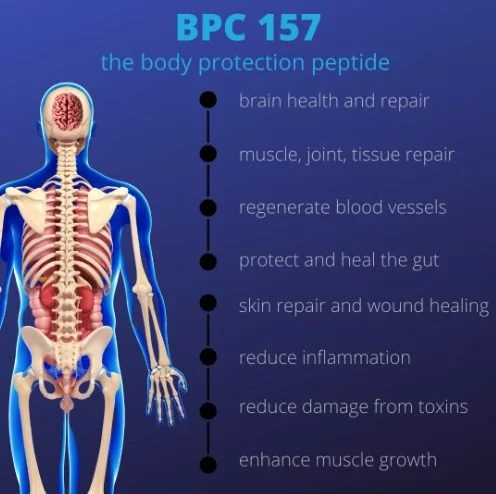
Orthopedic:
Tendon/ligament repair (rotator cuff, ACL)
Joint degeneration (osteoarthritis)
Fracture healing acceleration
Gastrointestinal:
Gastric ulcers, esophagitis
Inflammatory bowel diseases (Crohn’s, UC)
Leaky gut and intestinal permeability
Neurological:
Traumatic brain injury (TBI)
Spinal cord injury
Peripheral nerve crush or transection
Mood disorders (possible anti-anxiety effect noted in rats)
Cardiovascular:
Ischemic heart disease
Hypertension
Microvascular injury post-MI
Organ Protection:
Liver fibrosis, NSAID-induced nephropathy
Alcoholic hepatitis
Sepsis-related multi-organ dysfunction (in models)
Oral/Dental:
Accelerates healing of gums, mouth ulcers, post-surgical wounds
Skin/Wounds:
Burn and wound healing

In a mouse model of deep partial-thickness burns, topical or systemic treatment with BPC 157 significantly improved wound healing, increased skin strength and elasticity, reduced edema and inflammation, and preserved blood vessel integrity—outperforming standard silver sulfadiazine treatment.
https://www.frontiersin.org/journals/pharmacology/articles/10.3389/fphar.2021.627533/full
How BPC-157 Works: The Science Behind the Healing Power
BPC-157 is pleiotropic, meaning it affects multiple systems. Key mechanisms include:
Angiogenesis stimulation (VEGF upregulation)
What is Angiogenesis? Angiogenesis is the formation of new blood vessels from pre-existing ones. It's a vital process in: wound healing, tissue regeneration, muscle growth, and response to hypoxia.
What is VEGF? VEGF is Vascular Endothelial Growth Factor and promotes the growth of new capillaries.
After injury, tissue is hypoxic and often under-perfused. Angiogenesis solves this by:
Delivering oxygen and nutrients to the damaged area
Removing waste products and inflammatory debris
Providing a scaffold for tissue regeneration (especially in tendons, ligaments, and nerves)
Collagen production enhancement
Stimulates type I collagen and fibronectin formation, which are vital for tendon, ligament, and skin repair.
Fibronectin acts like a biological glue that helps cells: stick to each other and to the extracellular matrix, migrate to injured areas, and organize the structure of new tissue.
Enhances fibroblast migration, which is crucial for tissue matrix restoration.
Fibroblasts are specialized cells found in connective tissue that play a central role in wound healing and tissue repair.
Nitric oxide (NO) modulation:
Nitric oxide (NO) is a gas molecule naturally produced by your body that acts as a signaling molecule, especially important in the cardiovascular, nervous, and immune systems.
Nitric oxide tells your blood vessels when to open up to let more blood, oxygen, and nutrients through, especially where damage has occurred.
Nitric oxide supports blood flow and reduces oxidative stress
Anti-inflammatory Effects
Reduces key pro-inflammatory cytokines like TNF-alpha & IL-6.
Common autoimmune conditions like: rheumatoid arthritis, inflammatory bowel disease, and multiple sclerosis often use anti-TNF drugs like Humira, Remicade, or Enbrel for treatment management.
Inhibits NF-kB pathway (a major cellular signaling pathway that controls the body’s inflammatory response, immune activity, and cell survival).
Might help reduce or regulate an overactive immune response, specifically in autoimmune diseases.
Upregulation of FAK-paxillin pathway
What is the FAK-paxillin pathway? It’s a cell signaling system your body uses to repair and rebuild tissues, especially tendons and ligaments.
FAK (Focal Adhesion Kinase) and paxillin are proteins that help cells:
Stick to injured areas
Move to where they’re needed
Grow and rebuild the tissue
Neuroprotective Effects
Promotes neurite outgrowth, synaptogenesis, and nerve regeneration. Neurites are extensions that come from nerve cells (neurons)- such as axons or dendrites.
Appears to protect dopaminergic neurons (shown in Parkinson’s disease animal models)
Enhances Brain-Derived Neurotrophic Factor (BDNF) signaling in some rodent studies. BDNF is a protein that plays a critical role in brain function, especially in areas like memory, learning, and overall cognitive health.
Cytoprotection & Organ Repair
Shown to protect:
Gastric mucosa (ulcers, NSAID-induced damage)
Liver (ethanol, carbon tetrachloride toxicity)
Kidneys (nephrotoxin exposure)
Heart (post-infarct repair)
Brain & spinal cord (traumatic injury, ischemia)
Dosing & Frequency
Note: These are not FDA-approved protocols and are based on user reports and animal research.
Standard Dosing: 200–500 mcg/day - Can be split into two doses for even absorption
Localized injection: Intramuscular or Subcutaneous; near site of injury
Systemic Healing: For gut healing, systemic inflammation, or unknown injury location; inject in belly fat; may be taken orally (possibly helpful for GI issues)
Cycle Duration: 2–6 weeks; Can be extended with breaks in between
Postcycle Phase: 2–4 weeks off; Reduces risk of desensitization or unknown long-term effects
Peptide Calculator: https://particlepeptides.com/en/content/48-peptide-calculator
What Are the Risks? What You Need to Know Before Using BPC-157
Generally well-tolerated in animals, even at high doses
Minimal acute side effects in human anecdotal use: redness, itching, headache, dizziness
Theoretical Concerns:
Excessive angiogenesis could be risky in:
Cancer (tumor vascularization)
Diabetic retinopathy
Long-term effects unknown — no formal chronic exposure studies in humans
So far, BPC-157 has shown a high safety profile in animal models, even at very high doses.
Legality
FDA status: Not approved for human use
Classification: Research chemical (sold for lab use only)
Important: BPC-157 use in athletes may violate anti-doping codes depending on federation.
Human Studies: Evidence- Limited; A few case reports and unregistered trials exist; no FDA-recognized trials yet
A small Phase I trial (42 healthy volunteers, doses 0.25–2 μg/kg oral) was completed but never published, and results remain unavailable
Stacking with Other Compounds
BPC-157 is often stacked with:
TB-500 – for synergistic tissue repair (BPC for localized, TB-500 for systemic)
GH peptides (CJC-1295, Ipamorelin) – to promote overall regeneration
Glutamine & collagen – to support gut and connective tissue repair
NSAID alternatives – since BPC-157 helps mitigate NSAID-related GI damage
Bloodwork to Consider
CBC (Complete Blood Count): peptides can influence immune function
LFT (Liver function test): To make sure your liver is not being stressed
Inflammatory Markers (CRP, ESR): to assess if BPC-157 is helping reduce inflammation
Testosterone panel, growth hormone (GH), and IGF-1 (Insulin-like Growth Factor): important when used alongside other growth and recovery peptides
It’s a good idea to get a baseline reading of your health status so you can track any changes or improvements as you use the peptide. If you're using BPC-157 long-term, periodic blood work every 3-6 months can ensure there are no negative side effects and that the peptide is contributing to your healing goals effectively.
Best Practices if Considering Use
Bloodwork before, during, and after use can be helpful
Start with low doses
Source from reputable peptide companies (check for independent COA testing-third party testing)
Purity: Should be >98% pure peptide
Avoid pre-mixed solutions unless from a trusted compounding pharmacy
Peptides typically don’t require refrigeration when in lyophilized powder form, but reconstituted peptides should be stored in a refrigerator and used within 30 days
While BPC-157 shows immense potential for healing and recovery, understanding your body’s specific needs and consulting with a healthcare professional will ensure that you get the most out of this powerful peptide in a safe and effective way.
Coming Up Next:
Part 3: “TB-500: Peptides Explained: Uses, Benefits, and Side Effects”